
Most of what we do is everyday brands, the Samsung fridge, the LG washer, the Whirlpool dryer in a normal Bay Area kitchen. The Sub-Zero 600 sits at the premium end of that, and yes, we service it. This is the short, practical read for an owner, not a technician’s deep dive. If you want the sealed-system craft side, our sister site adrium goes deeper on that.
What the 600 Series is
It’s a family, not one fridge. The 601R is the all-refrigerator, the 601F the all-freezer, often installed as a pair. The 601RG and 611G are the glass-door versions. The 611, 632, 642, 650, and 650G fill out the standard built-ins, and the 680 and 690 are the larger units with a second mechanical section. They come side-by-side and over-and-under. Not sure which you have? The serial tag is at the top door hinge inside, in the freezer on a side-by-side, in the fridge on an over-and-under. Model and serial both matter for parts, since Sub-Zero tracks production changes by serial.
Why dual refrigeration changes the call
The thing that makes a Sub-Zero a Sub-Zero is dual refrigeration: two separate sealed systems, one for the freezer, one for the fresh-food side. They don’t share air, which is why produce lasts.
For repair, that matters more than people expect. One side drifting warm while the other holds dead-on is not a whole-unit failure. It points at that side alone: its compressor, its evaporator fan, its thermistor, or a leak in that loop. We don’t condemn the unit over one warm compartment.
What you can check before calling
Five minutes, costs nothing:
- Power and settings. Breaker on, unit not in standby. Check the panel temperatures, someone bumping the controls warmer while cleaning is more common than you’d think.
- The condenser grille. Look at the top. Visibly packed with dust and lint alone causes warm temps with the compressor running nonstop. Vacuum the grille face from outside, then give it a day. Still warm, call.
- Door seals. Close the door on a sheet of paper and pull. Slides out easy at multiple spots, the seal’s failing.
That’s the limit of what makes sense at home.
What actually fails
- Clogged condenser. Packs with dust fast on a built-in. A proper clean means pulling the grille assembly and cleaning the coil and housing. It’s often the whole fix on a unit that was just running warm.
- Worn fan motors. The condenser and both evaporator fans run constantly. A dry bearing gets loud, then seizes. Replacement means getting into the mechanical section.
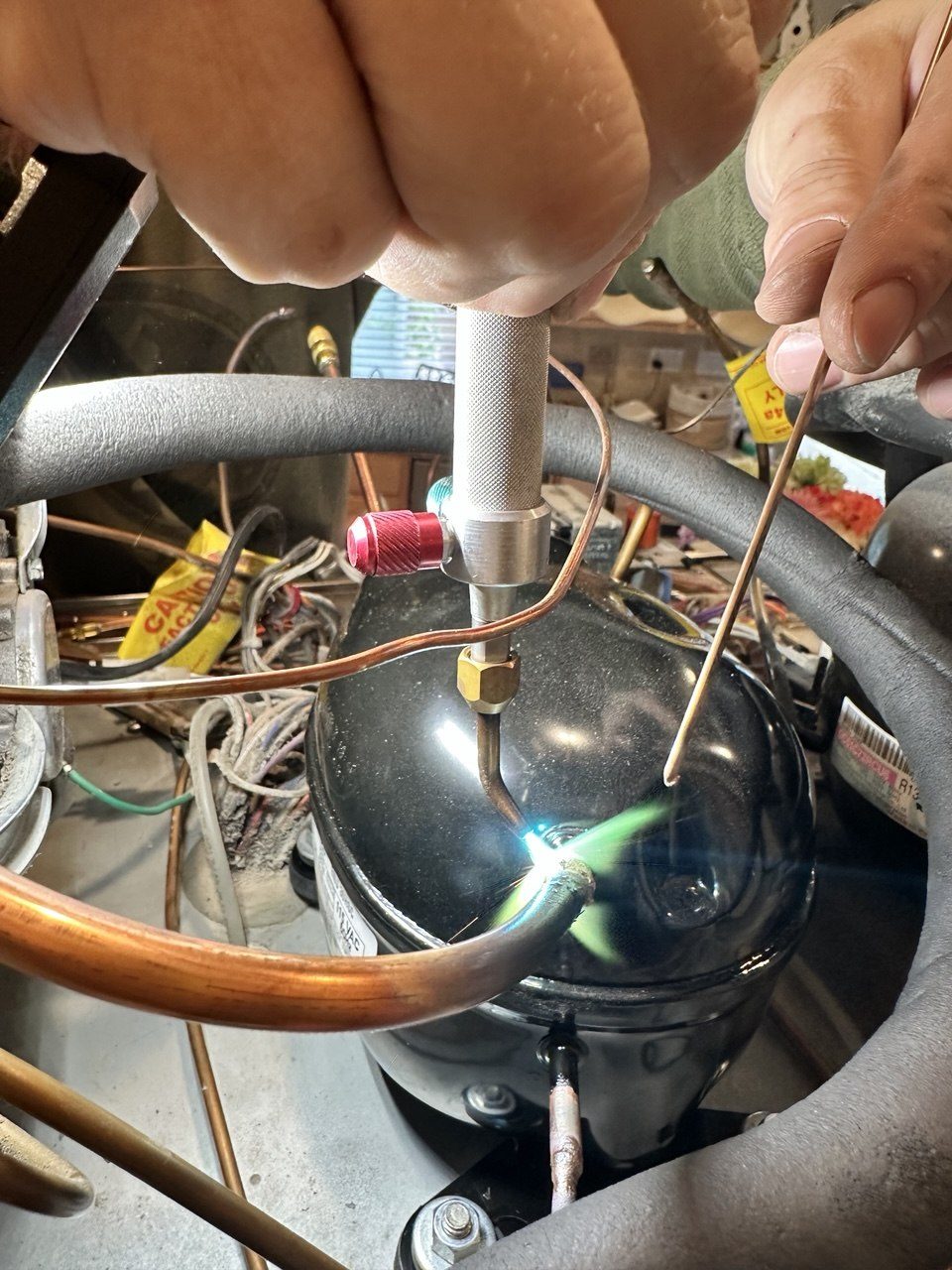
- Sealed-system leaks. One side slowly losing temperature while its compressor runs long is the classic sign. This needs EPA-certified refrigerant work and recovery gear, which we carry.
- Defrost faults. A failed heater, terminator, or sensor ices the evaporator until the compartment warms. We check components before pulling anything apart.
- Door and hinge wear. On heavy integrated doors the hinge cartridge wears and the seal gaps. Resetting it needs alignment specs for that model.
Why repair wins
A built-in is fitted to your cabinetry, and replacing one runs into five figures plus a refit. Even a sealed-system rebuild, the expensive outlier, reads as cheap against a new unit. It’s a $99 diagnostic, credited to the repair, then a written repair-or-replace call and price before any work.
Call us
Warm food is already costing you in spoilage, and a compressor running nonstop shortens its own life. Bay Area Appliance Repair Service covers San Ramon, Danville, Alamo, Blackhawk, Dublin, Pleasanton, Lafayette, Orinda, and the rest of the Bay Area. Licensed CSLB #1136642, EPA #1279674151528, BEAR #50788, A+ with the BBB. Schedule a visit at (925) 999-4095 or welcome@adriumservice.com, or book online.