
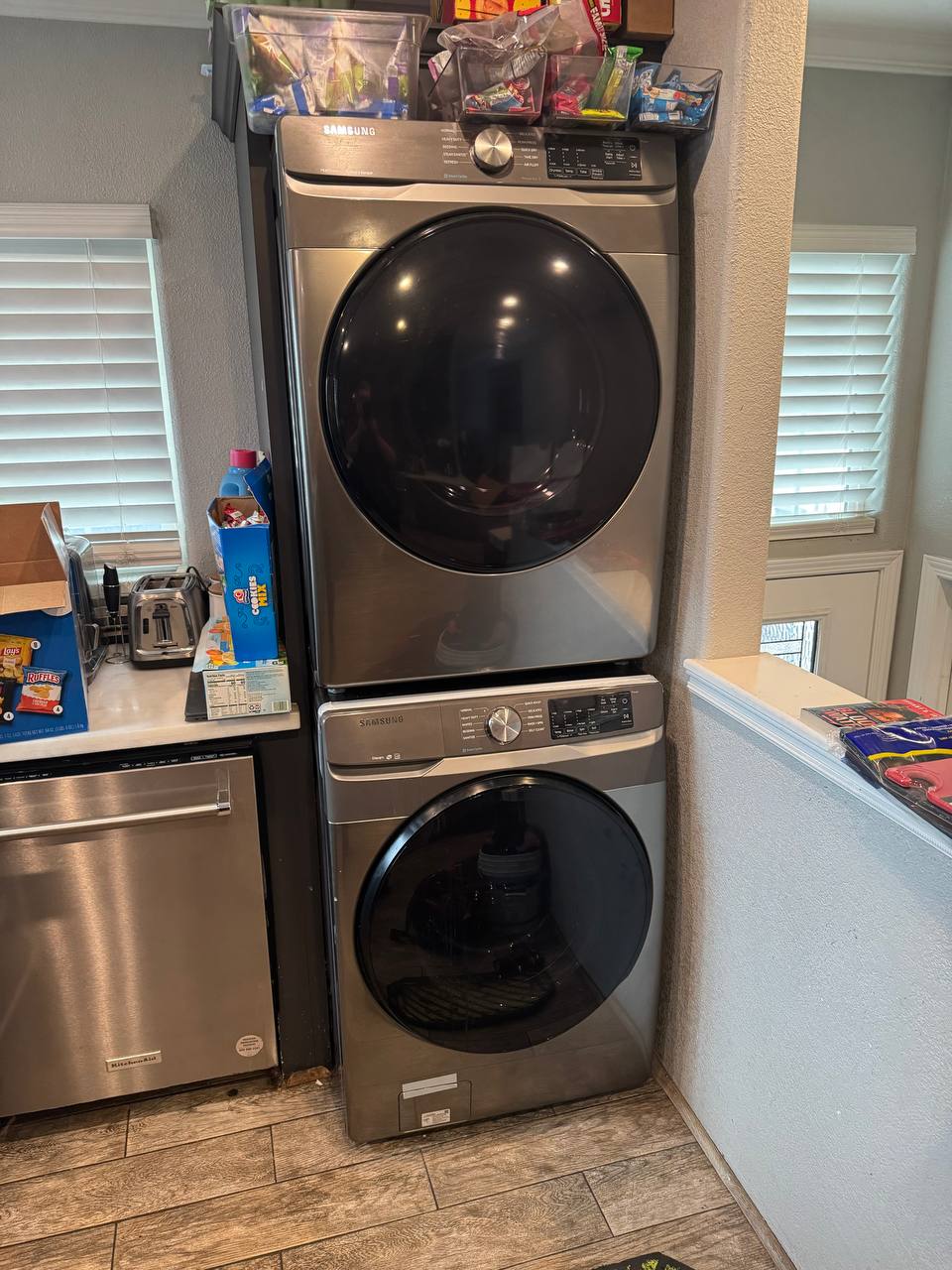
Finding water under the washer is one of our steadier laundry calls across the Bay Area. It’s almost always one of six things, and the job is pinning down which before it reaches the subfloor.
First, safety: unplug the washer and shut the hot and cold valves behind it. Water at the base of a live machine is a hazard, not a nuisance.
Here’s a fast way to narrow it: watch which part of the cycle makes the puddle. Fill, wash, or drain and spin each point at a different failure.
1. Drain pump (leaks on drain and spin)
The pump pushes water out during drain and spin. When its housing cracks or the internal seal wears, water escapes at the bottom of the cabinet, and only while the pump runs. Listen for a louder grind or buzz. A coin or hairpin lodged inside can crack the housing outright. We pull the access panel and eyeball the pump body to confirm.
2. Drain hose, split or loose (leaks at the back on drain)
The hose carries water from the pump to the standpipe or laundry sink. It cracks with age, the clamp backs off, or it works loose from the standpipe and backflows. Water at the rear corner during drain points here first. We check both ends and confirm the hose is seated properly in the standpipe.
3. Worn tub seal (leaks during wash and spin, grows over time)
Where the inner tub meets the drive shaft there’s a seal. As it wears, water slips past onto the base of the machine, then to the floor. On a front-loader the door boot is a second seal that tears and drips at the lower front. A failing tub seal often shows up alongside a failing bearing, and since the machine has to come fully apart, this is one of the heavier jobs on the list.
4. Too much detergent (not hardware at all)
High-efficiency washers use very little water. Overdose the detergent, or run regular non-HE soap, and the suds overflow the tub and run to the floor. It looks exactly like a leak. Run a rinse-and-spin with no soap and no clothes. Floor stays dry? That was your “leak.” Switch to HE detergent at half the dose you’d guess. Most people overdose by a wide margin. This is the one you can fix yourself.
5. Cracked outer tub or sump (steady leak most of the cycle)
A cracked tub or sump dumps water straight down. Cracks come from age, a heavy off-balance load slamming the tub, or an object wedged where it shouldn’t be. Locating it means opening the machine, and on a lot of units the parts-and-labor for a tub is high enough that replacing the washer is the smarter money. We say so plainly when the math points that way.
6. Loose or failed inlet fitting (leaks on fill)
The inlet valve and its fittings sit at the back where the supply hoses connect. A loose connection, a cracked fitting, or a valve leaking through drips at the rear, and the water tracks forward under the machine. This one shows during fill, when fresh water is coming in. If the fill hoses look loose back there, note it. If the drip keeps up with the water on but the machine unplugged, the inlet valve itself is leaking through and needs replacing.
When to call a pro
If the no-soap rinse test came back dry, you’re done: HE detergent, lower dose. Everything else means moving the machine, pulling panels, or a full teardown. Get the order wrong on a front-loader and you damage parts that cost more than the original repair. A tub-seal job that turns out to need a bearing too doubles the labor. These aren’t hard jobs for someone who does them every day. They are for someone who doesn’t.
We handle all of it under laundry repair. If the machine also won’t drain or spin, the washer and dryer repair guide walks through those symptoms too.
Water under your washer? Call Bay Area Appliance Repair Service at (925) 999-4095 or email welcome@adriumservice.com. The $99 diagnostic is credited to the repair when you book the work, and you get the price in writing once we find the source. You can also reach us through the contact page.
FAQ
Why is my washer leaking only during the spin cycle? A spin-only leak usually means the drain pump, a loose drain hose, or the tub seal failing under pressure. Note which step starts the puddle. That alone narrows it to the drain side of the machine.
Can too much detergent make a washer leak from the bottom? Yes. Excess or non-HE soap makes suds that overflow and run to the floor. Run a soap-free rinse. If it stays dry, switch to HE detergent at half the dose.
Is it safe to keep using a leaking washer? No. Unplug it, shut the valves, and stop running loads until the source is found. A slow drip today warps the subfloor in a month.