

Plenty of Peninsula kitchens run their cold storage on a Sub-Zero built-in: a 36 or 48-inch Classic, a pair of integrated columns flanking the prep zone, an undercounter unit tucked into the pantry. These disappear into the cabinetry, which is the point, and it is also why a failure is rarely simple and never cheap to get wrong.
We are Bay Area Appliance Repair Service. Our day-to-day is everyday appliance work across the whole Bay Area, fridges, washers, dryers, dishwashers, and ranges on every major brand. Sub-Zero built-ins are part of that, and after fifteen-plus years on them the call sheet is short and predictable. Here is what we actually see, what an owner can safely check, and where the line sits between a reset and a service call.
The failures we see most
Caked condenser coils. The number one reason a built-in runs warm. The grille up top pulls air across the coil, and behind a decorative panel that airflow is already tight. Dust cakes the coil in about two years, the compressor runs hot, cooling falls off, and eventually the compressor pays for it. This one is partly preventable.
Fan motors, condenser and evaporator. On the Classic 36 and 48-inch units, a dry condenser-fan bearing starts as a faint hum and ends as a seized motor and a warm box. Evaporator fans go the same way. A Sub-Zero making a noise it never used to is giving you early warning.
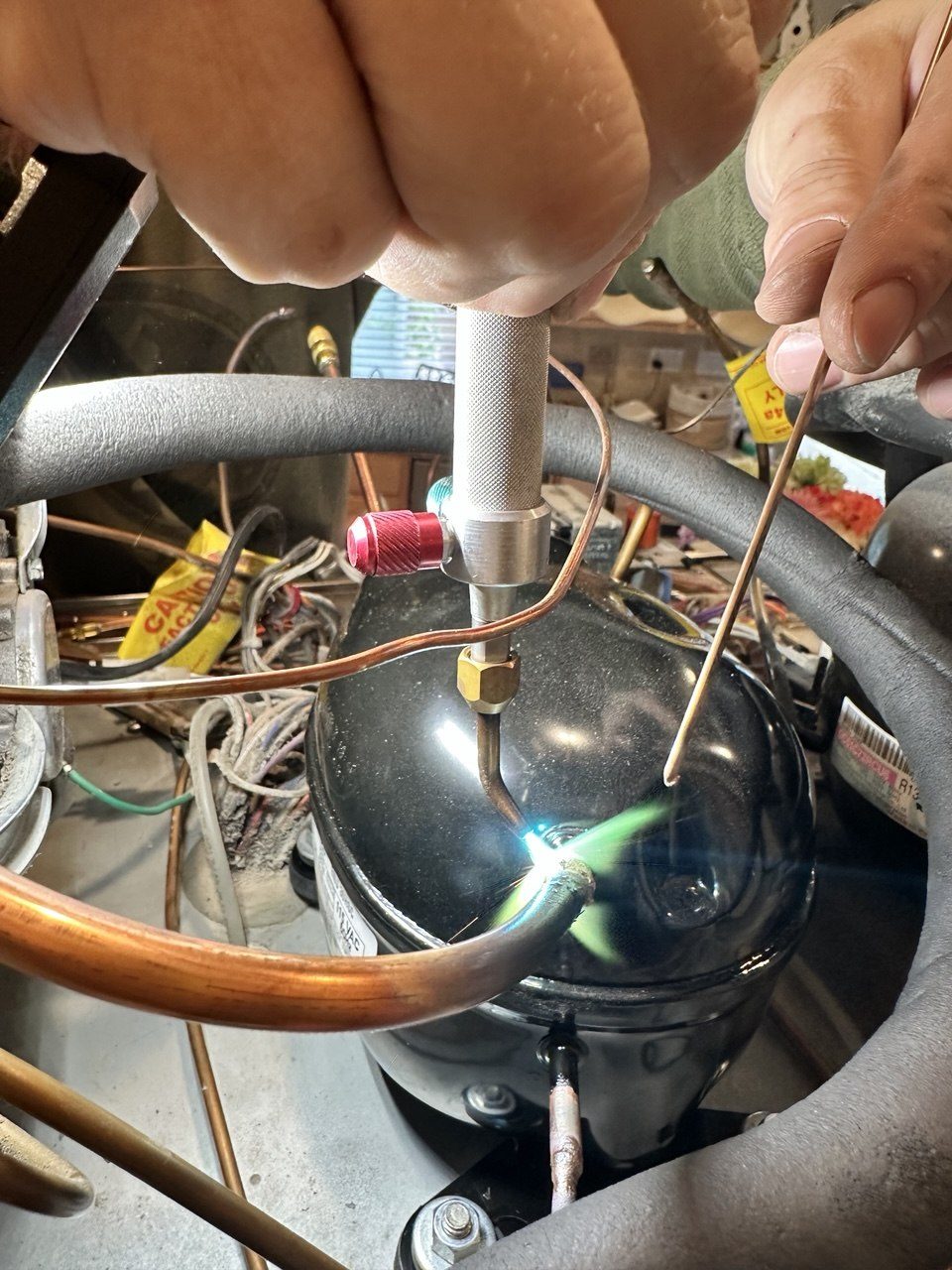
Sealed-system leaks on the 600 and 700 series. Older built-ins lose cooling slowly on one side. Fresh food drifts into the low 50s while the freezer holds, or the reverse. That pattern means a sealed-system leak, the most expensive repair on the unit, and done wrong it becomes a $4,000 callback. That is why we run gauges, a micron meter, and a recovery machine on the truck.
Dispenser boards on older Classic units. Classic symptom: ice dispenser dead, water still flowing, panel lights normal. Parts availability on older Classic boards varies, and rebuilt options exist through third-party refurbishers. We confirm sourcing before ordering, because a bad harness or a dispenser switch mimics the same fault.
What an owner can check first
A few things are genuinely worth doing yourself:
- Clear and vacuum the top grille. Pop the grille, vacuum the visible coil and the area around the fan. On many warm-running units this alone restores cooling. Do it twice a year on an integrated install.
- Check the door seal. Run a dollar bill around the magnetic gasket and close the door on it. If it slides out with no drag, the seal is tired and the unit is fighting warm room air.
- Confirm nothing blocks airflow. A panel pushed too tight, a towel over the grille, boxes against the condenser intake. These cause “broken fridge” calls that are not broken.
That is the safe list. Everything past it touches refrigerant or sealed components.
Where to stop and call
Stop the moment you are looking at one side cooling and the other not, a fan you cannot reach without pulling the unit, or anything on the sealed system. Built-in columns are heavy, set into millwork, and tied to custom panels. Pulling one without protecting the cabinetry is how a repair turns into a finish-carpentry bill.
We service Sub-Zero built-ins across the Peninsula, including Atherton and Hillsborough, as part of our refrigeration repair work. For the brand rundown, see our Sub-Zero overview, and if your unit is warming up right now, our guide on a Sub-Zero that stopped cooling walks the five usual causes.
The $99 diagnostic is credited to the repair when you move forward, and after we look you get a written repair-or-replace call and a price before any work past diagnosis. To book, reach Bay Area Appliance Repair Service at (925) 999-4095 or email welcome@adriumservice.com. CSLB #1136642, EPA #1279674151528, BEAR #50788, BBB A+. You can also schedule a visit through our contact page.
What sealed-system work looks like
FAQ
How much does Sub-Zero built-in repair cost? The scope depends on what fails. We diagnose the unit on site for $99, credit that amount toward the repair, and provide the actual repair price in writing before work starts.
Why does one side of my column cool and the other does not? Each column runs its own sealed system. One side warm while the other holds points to that column’s compressor, evaporator fan, or a leak. It needs gauges to confirm.
Do you work on integrated, panel-ready units? Yes. We pull and re-hang custom panels carefully and protect the surrounding cabinetry, which is most of what these kitchens require.